


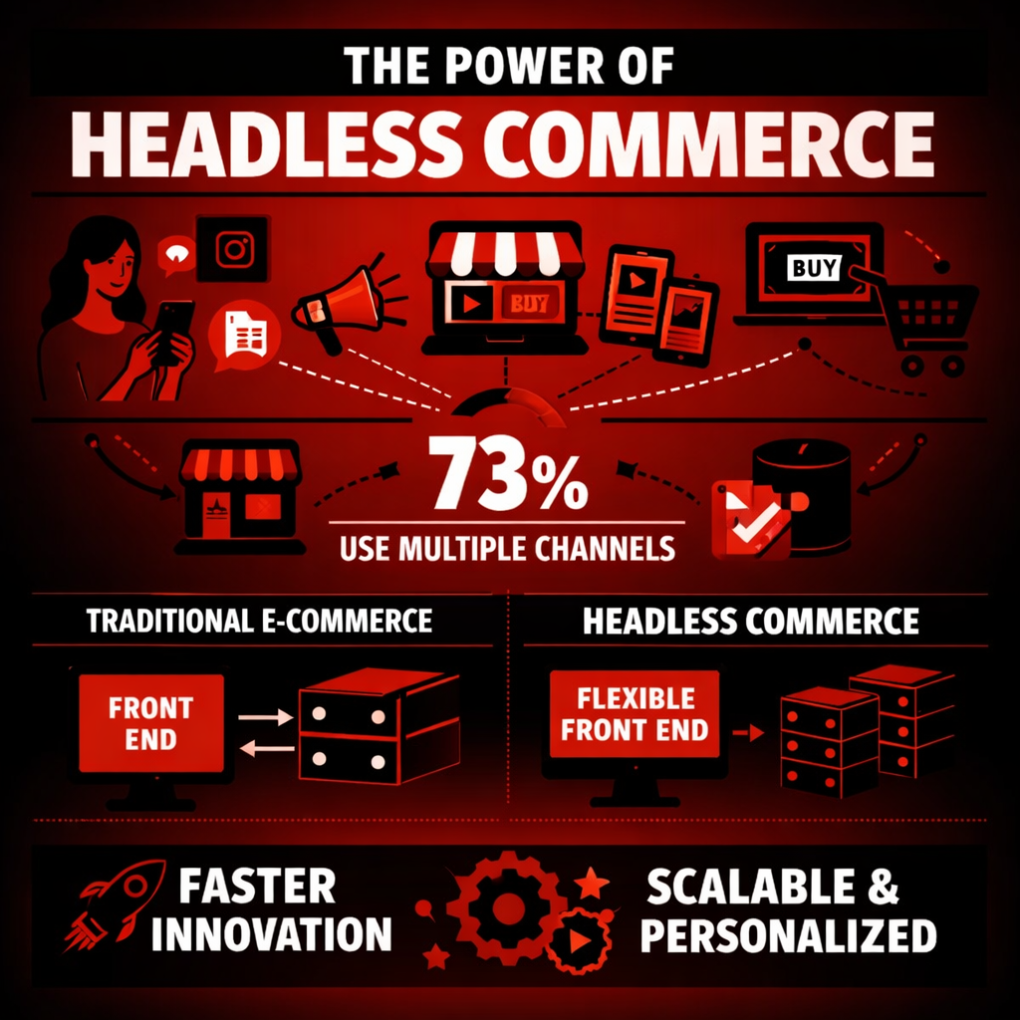
E-commerce today is no longer limited to a single website. Customers discover products on Instagram, compare prices on marketplaces, browse through mobile apps, and sometimes even purchase through voice assistants. The modern buying journey is dynamic, multi-channel, and experience-driven.
According to industry reports, over 73% of consumers now use multiple channels during their shopping journey, which means businesses must provide consistent experiences across platforms.
Traditional e-commerce systems were not designed for this level of complexity. In most platforms, the frontend design and backend functionality are tightly connected. While this works for businesses just starting out, it often slows innovation as companies grow.
This is where headless commerce changes the game.
Headless commerce separates the customer-facing experience from the backend commerce engine. This approach allows brands to create faster, more personalized, and scalable digital shopping experiences without affecting backend operations.
Simply put, headless commerce allows businesses to innovate faster while keeping their core systems stable.
What is Headless Commerce?
Headless commerce is an e-commerce architecture where the frontend (what customers see) is separated from the backend (where commerce operations happen).
In traditional platforms, everything is connected. Product pages, design templates, checkout systems, and inventory management operate within one monolithic system. Because of this structure, even small design changes may require backend development.
With headless commerce, these layers are separated.
The backend manages:
- Product catalogs
- Inventory and stock levels
- Customer accounts
- Order management
- Payment processing
The frontend manages:
- Website design
- Mobile app interfaces
- User interactions
- Content presentation
These layers communicate using APIs (Application Programming Interfaces), which transfer data between systems.
Because of this separation, businesses can update the customer experience without modifying the backend infrastructure.
How Headless Commerce Works
Headless commerce operates through an API-driven architecture.
The backend stores essential commerce data such as product catalogs, pricing, orders, and customer information. APIs expose this data to various frontends.
The frontend then pulls this information and displays it across different channels such as:
- Websites
- Mobile applications
- Social commerce platforms
- Smart devices
- In-store kiosks
For example, a customer might discover a product on social media, browse it on a website, and complete the purchase through a mobile app. All of these experiences connect to the same backend system.
This flexibility makes headless commerce ideal for modern omnichannel retail strategies.
Traditional Commerce vs Headless Commerce
Traditional commerce platforms are usually monolithic systems, meaning the frontend and backend are tightly connected.
While this makes it easier to launch an online store quickly, it becomes restrictive as businesses grow.
Headless commerce separates the system into independent layers, giving businesses greater control and flexibility.
Traditional commerce typically offers:
- Faster initial store setup
- Limited customization
- Slower updates and innovation
- Difficult multi-channel integration
Headless commerce provides:
- Complete design freedom
- Faster experimentation and testing
- Easy integration with multiple platforms
- Better performance optimization
This flexibility is one reason why over 60% of enterprise retailers are already exploring or adopting headless architecture.
Why Headless Commerce is Growing Rapidly
Omnichannel Commerce
Modern consumers interact with brands through many platforms. They might discover a product on social media, research it through search engines, and purchase it through a mobile app.
Research shows that omnichannel customers spend up to 30% more than single-channel shoppers.
Headless commerce supports this behavior by allowing multiple frontends to connect to a single backend system. This ensures consistent pricing, product information, and inventory across all channels.
Faster Website Performance
Website speed has a direct impact on user experience and conversions.
Studies show that:
- 64% of mobile users expect pages to load in under 4 seconds
- 40% of users leave a website if it takes more than 3 seconds to load
Headless commerce allows developers to use modern frontend technologies that load faster and deliver smoother user experiences.
Even small improvements in page speed can increase conversions and reduce bounce rates.
Greater Creative Freedom
Traditional platforms often rely on predefined templates, which limit customization.
Headless commerce removes these restrictions.
Businesses can design completely customized storefronts, interactive shopping experiences, personalized product pages, and unique checkout flows.
This level of creative control helps brands stand out in highly competitive markets.
Easier Technology Integration
Most businesses already use multiple software tools for operations and marketing.
Headless commerce integrates easily with systems such as:
- CRM platforms
- ERP systems
- analytics tools
- marketing automation software
Because of the API-first architecture, businesses can connect these tools without disrupting their entire platform.
Key Technologies Behind Headless Commerce
Headless commerce relies on several core technologies.
Commerce Platforms
Modern e-commerce platforms provide backend functionality such as product management, checkout systems, and payment processing.
Popular platforms supporting headless architecture include:
- Shopify
- BigCommerce
- Adobe Commerce
These platforms handle transactions and data while allowing frontend flexibility.
Frontend Frameworks
Frontend frameworks power the customer experience and improve performance.
Common frameworks include:
- Next.js
- Gatsby
- Vue.js
These technologies improve page speed, responsiveness, and SEO performance.
APIs
APIs are the backbone of headless commerce.
They allow different systems to communicate with each other by transferring product data, order details, and customer information.
Because APIs are flexible, businesses can integrate new tools and technologies without rebuilding their entire platform.
Benefits of Headless Commerce for Modern Brands
Complete Customization
Brands are not restricted by templates. They can design unique shopping experiences that match their brand identity.
Faster Multi-Channel Expansion
Businesses can launch new channels quickly. For example, they can add mobile apps, social commerce integrations, or international storefronts without rebuilding their backend system.
Improved SEO Performance
Headless commerce often uses modern frameworks that improve technical SEO.
Benefits include:
- Faster page loading speeds
- Better Core Web Vitals performance
- Improved mobile optimization
- Flexible structured data implementation
These improvements help businesses rank higher in search engines.
Scalability
As businesses grow, traffic and product catalogs increase.
Headless systems allow companies to scale more efficiently by upgrading individual components instead of the entire platform.
Challenges of Headless Commerce
Despite its advantages, headless commerce requires careful planning.
The initial setup can involve higher development costs compared to traditional platforms. Enterprise headless projects may require significant investment depending on customization and integrations.
Businesses also need skilled developers to manage frontend frameworks, APIs, and infrastructure.
However, for companies focused on long-term growth and innovation, the benefits often outweigh the upfront investment.
When Should a Business Use Headless Commerce?
Headless commerce works best for businesses that:
- Sell across multiple digital channels
- Need advanced customization
- Require faster website performance
- Plan to expand internationally
- Have complex technology ecosystems
Many businesses start with traditional platforms and move to headless architecture as their digital operations grow.
The Future of Headless Commerce
The future of digital commerce is moving toward API-first and composable architectures.
Technologies like artificial intelligence, augmented reality shopping, and voice commerce require flexible systems that traditional platforms cannot easily support.
Industry forecasts suggest that the global headless commerce market could surpass $30 billion within the next few years, highlighting the growing demand for flexible e-commerce infrastructure.
Businesses that invest in scalable, adaptable systems today will be better positioned for future growth.
Conclusion
Headless commerce represents a major shift in modern e-commerce architecture. By separating frontend experiences from backend systems, businesses gain the flexibility to innovate quickly while maintaining operational stability.
The approach offers several advantages, including improved performance, greater design flexibility, omnichannel capabilities, and stronger scalability.
While implementation requires technical planning and investment, headless commerce is quickly becoming the foundation of modern digital commerce.
For businesses that want to deliver exceptional customer experiences and stay competitive in the evolving online marketplace, adopting a headless architecture can provide a powerful strategic advantage.
- Future-ready scalability
In 2026, headless commerce is not just an upgrade — it is becoming the new standard for businesses that want to lead, innovate, and scale in the digital marketplace.
If your goal is to build a high-performance, scalable, and customer-centric e-commerce brand, headless commerce is the strategic move that positions you ahead of the competition.
